
Faucet Holes and Square Mortises in Vanity Top, Washington Heights. Before and After
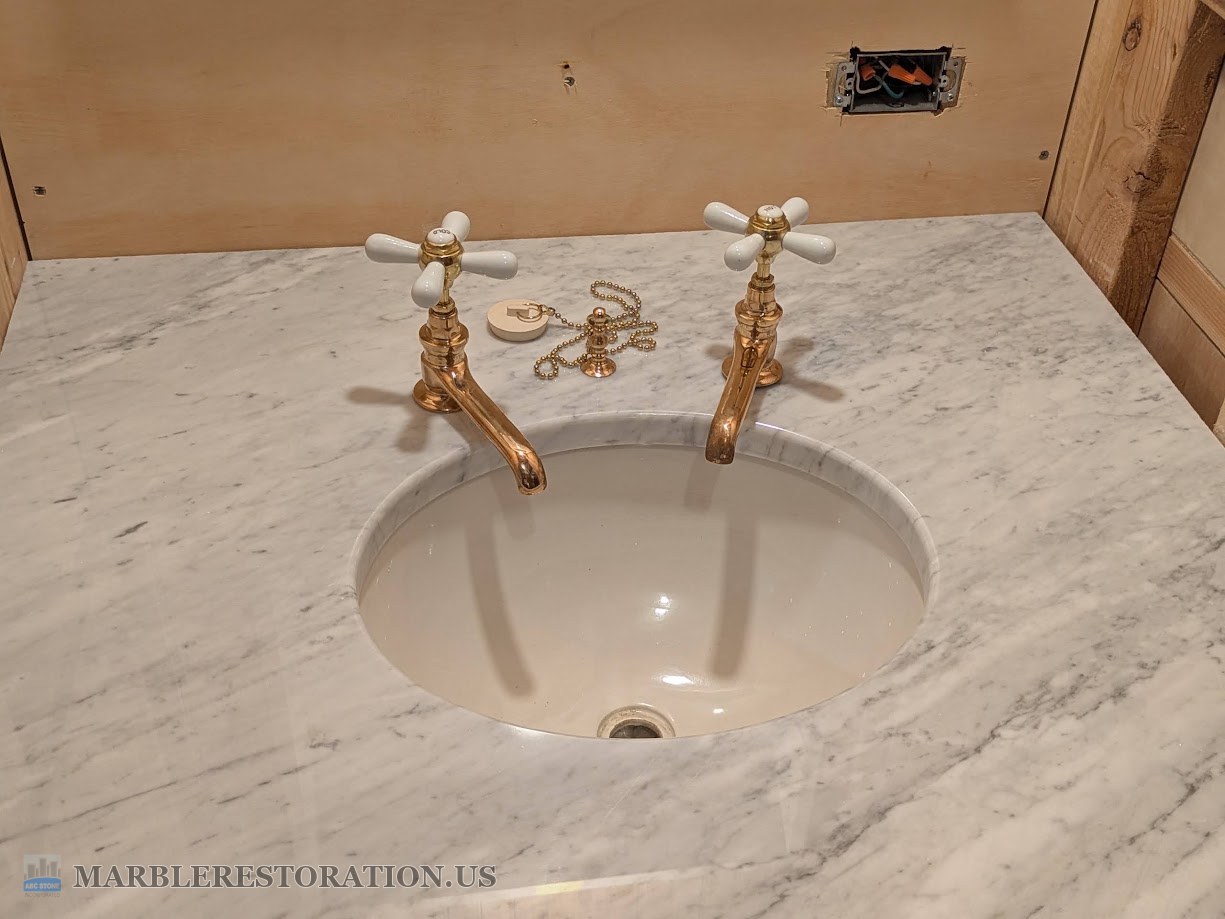
Drilling and mortising a Carrara marble vanity top for two old-style faucets. The sink basin was already installed. The top needed two faucet holes, 7/8 inch in diameter, and one small hole for the drain plug stanchion. Round holes alone were not enough. Each faucet has a square-cast element at the top of its threaded neck, and it needs a square recess in the stone. The recess points the faucet in the right direction and keeps it from rotating. The house is in the Jumel Terrace Historic District, by the Morris-Jumel Mansion, in Washington Heights, Upper Manhattan, New York County, NY 10032.
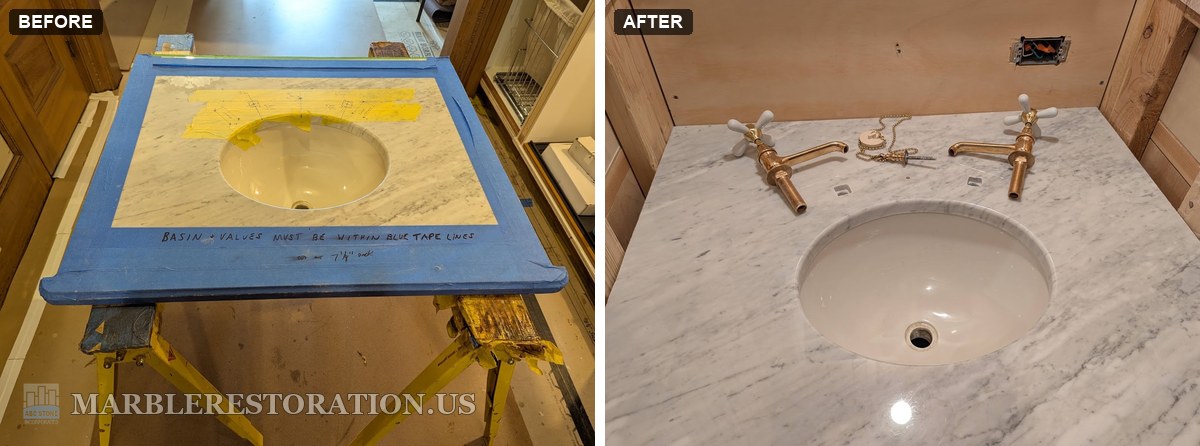
A new countertop made for old faucets
I cut and edged this countertop two summers ago from a new 3 cm Carrara slab. Its molded front edge matches an antique sink I had worked on for the same owners. The sink basin was installed under it after that. Then they picked the faucets: two separate taps with white cross handles, one hot and one cold, the way bathroom sinks were set up around 1890. The row houses on this block went up in 1896, so a setup from about 1890 fits the house. There was no mixer then, each faucet stood on its own, like on an antique countertop in a Brooklyn brownstone I restored.
The owners sent a photo of a ca. 1890 countertop with the same basic setup they wanted.
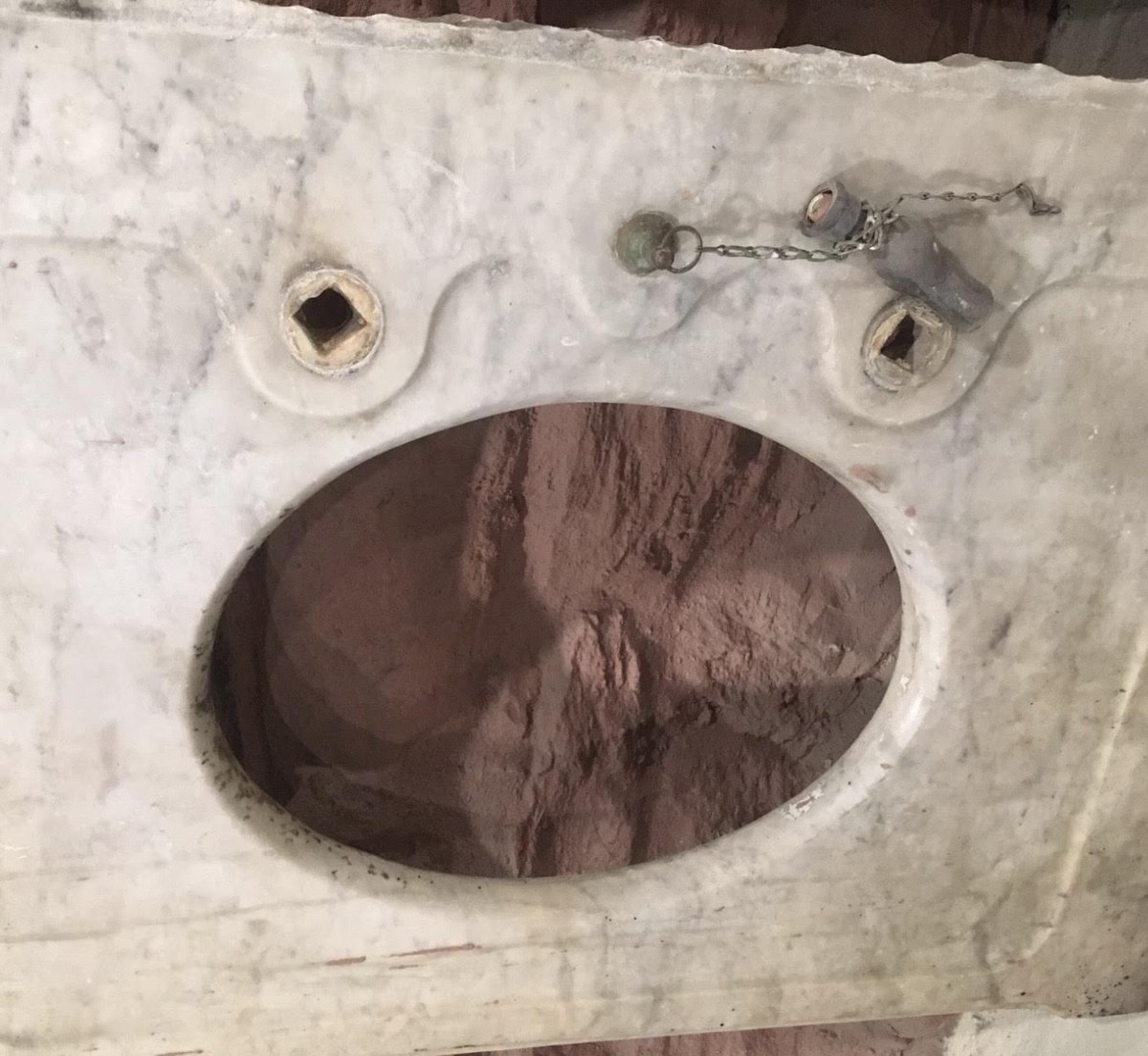
Three holes, two square mortises
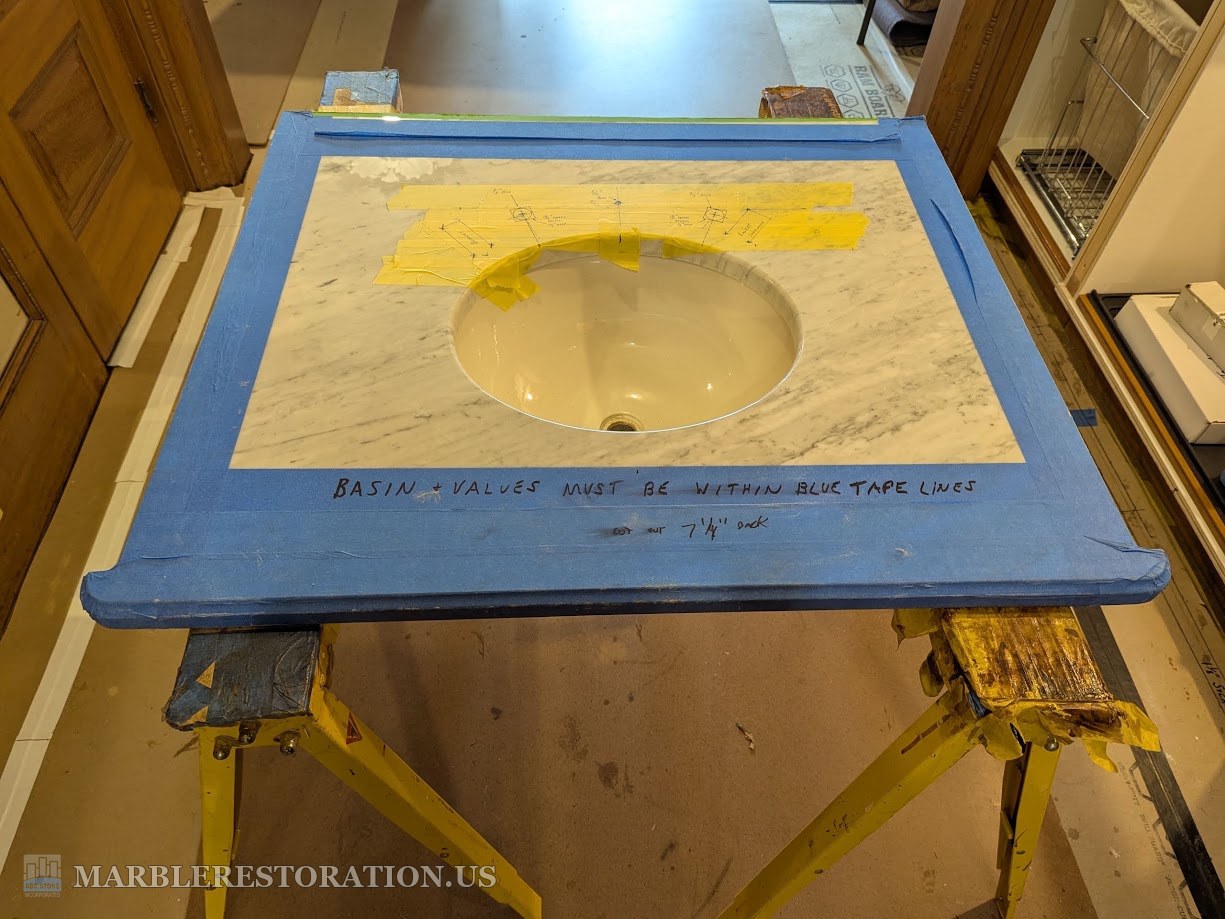
The job was two faucet holes, about 7/8 inch in diameter, and one small hole, about 5/16 inch, for the drain plug stanchion, the small post the plug chain hangs from. The owners marked the hole centers on yellow tape.
Each faucet hole has two parts. At the top is the square mortise, about 15/16 inch square and about 1/2 to 3/4 inch deep, where the square-cast element of the faucet sits. Below it is a round hole the rest of the way through the slab for the threaded neck. The other choice was bigger round holes with no square recess, with the faucets held by the nuts underneath or set with silicone. We looked at the slab on the work day and went with the mortises.
The top wasn’t on the cabinet yet, so I drilled it on the sawhorses. Then the owner and I moved it onto the cabinet.
The round holes are the quick part. A drill only cuts round, so each mortise is made by hand, from the round hole out to the corners. That’s small drill holes, rotary tool cuts, chipping, chiseling and filing, a little at a time. I measure the square-cast part of the faucet myself before cutting, because the size on paper and the real casting are not always the same. It took one long day.
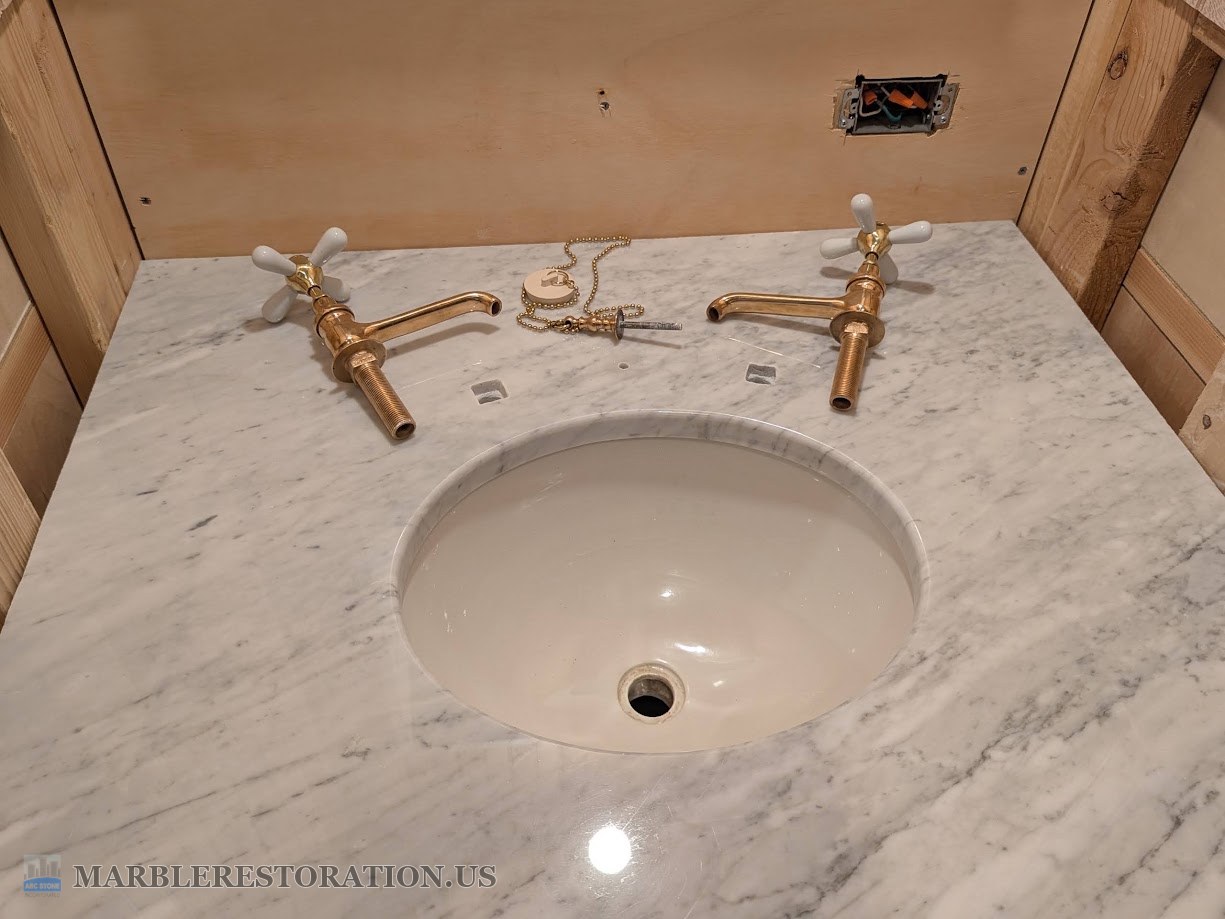
What the mortises look like up close
The faucets sit right, but here is what to expect from square holes in stone:
- The corners of the squares come out slightly rounded. A bit and a blade can’t cut a perfectly sharp inside corner. The square-cast part of the faucet still sits in it and can’t rotate.
- The depth of the recess is not exact. These came out about 1/2 to 3/4 inch deep.
- A hole can come out a little bigger than marked, by about 1/16 to 1/8 inch. The faucet base covers the edge.
- The walls of the holes are not polished. They are hidden under the faucet, and polishing isn’t needed there.
- The drilling makes some dust and noise. The area around the work gets covered with plastic.
- I cut the holes only. Setting the faucets, the plumbing and the caulking are separate work.
Why a square mortise takes longer than a round hole
Carrara is a soft marble next to granite or quartz, so a round hole goes in fast. Compare a faucet hole in a quartz countertop or one in granite, where the drilling itself is the job. A square can’t be drilled, so most of the day here went into the two squares, not the three holes.
Questions people ask about faucet holes in marble
Can you drill faucet holes in a marble countertop that’s already installed?
Yes. I drill it where it is, the top doesn’t need to come out. The cabinet and the area around it get covered.
Can you cut a square recess or mortise in marble?
Yes. A square recess on top of a round hole, like here, or a square mortise all the way through. The corners come out slightly rounded, not sharp.
Should the faucets be there on the work day?
Yes. I measure the faucets myself before drilling and mortising.
If you’re setting antique or old-style faucets in a marble countertop, or need holes drilled in a counter that’s already in, send me a photo of the top, the faucet or its spec sheet, and how many holes you need, what size and where. I’m based in Brooklyn and work all over New York City, including Manhattan. Email info@marblerestoration.us.
Submit Your Order or Ask a Question:
You'll get a response within a few minutes or hours and usually not longer than 24 hours.
 Countertop Hole Drilled for Faucet
 Granite Countertop Faucet Hole Drilling
 Counter Marked for Faucet Hole Drilling
 Holes Drilling for Brackets Mounting/Shelf Installation
 Engineered Quartz Countertop Core Drilling
 3-Inch Hole Drilled Through Engineered Quartz Countertop
 Circle Marked Out for Hole Drilling in Countertop
 Two Ways to Cut a Countertop Opening for a New Cooktop or Sink
 Travertine Round Coffee Table Fabricated
 Stone Cutting & Custom Fabrication Service
 Polished Rectangular Piece. Botticino Marble
 Through cutout (standard drop-in) in Granite
 Granite Counter top Cook top Cutout
 Round Dining Table before Cutting and Modifications
 Custom Insert into Counter Edge after Fabrication & Installation
 Tarnished & Dull Rectangular Marble
 Countertop Custom Insert Fabrication & Installation
 Window Niche Ground Up and Door Fitted to Open
 Marble Shelf Installation
 Green Serpentine Counter Double Edge before Revamping
 Double Edge on Black Counter before Disjointing & Revamping
 Missed Piece of Onyx behind Pipe Hiding
 Botticino Marble Raw Piece Trimming
 Raw Cut Edge before Revamping on Serpentine Counter