
Two Ways to Cut a Countertop Opening for a New Cooktop or Sink
When a new cooktop or sink goes into a countertop that is already installed, the opening in the stone almost never matches the new appliance. A cooktop might be a little deeper, a sink a little wider, and the old hole no longer fits. The marble or granite has to be modified so the new piece sits the way it should. There are two ways to make that opening, and the appliance itself is what decides which one you need.
Both are done on-site, on the stone you already have. The difference is simple to picture. One cut goes straight through the stone so the appliance drops in and rests on top. The other leaves a shelf part way down so the appliance sits lower and finishes flush with the surface. The drawing below shows both in cross-section.
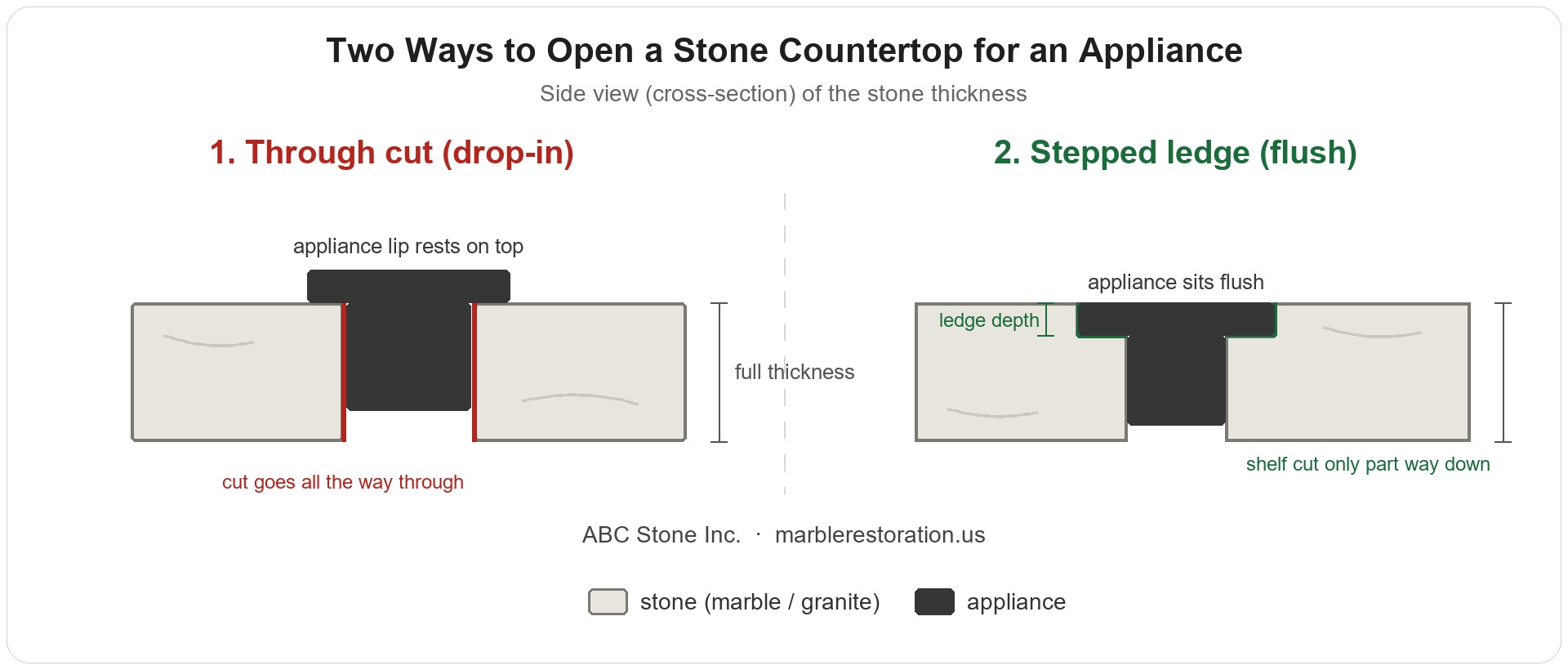
The through cut, or standard drop-in opening?
This is the common one. The opening is cut all the way through the full thickness of the stone, and the new appliance drops in from the top. Its rim, or lip, rests on the surface around the hole and holds it in place. If you look at most kitchen sinks or cooktops with a visible edge sitting on the counter, that is a through cut underneath.
It suits any appliance built to sit on top of the surface. Drop-in and self-rimming sinks, framed cooktops in both gas and induction, and slide-in ranges all work this way. As long as the unit has a lip made to rest on the stone, the through cut is the natural choice.
The work itself is straightforward. We take the size from the appliance or its spec sheet, mark the line, and cover the area with plastic to hold the dust. Then the line is scored and cut through with a diamond blade, the cut piece comes out, and the edges of the opening are shaped and smoothed before the appliance is test-fit.
The main reason people go with a through cut is that it is simpler, faster, and costs less. It also forgives small differences in size, because the lip of the appliance covers the edge of the cut and hides any tiny gap. The trade-off is the look. The lip sits a little above the stone, so there is a small raised edge where crumbs and water can gather, and it does not give the clean, level finish that a flush install does.
The stepped ledge, or flush recessed opening?
The second way is more refined. Instead of cutting straight through, we cut a shelf, also called a rebate or recess, part way down into the top of the stone around the opening. The appliance drops into that shelf, and its top ends up level with the surface. Run your hand across it and the stone and the appliance feel like one continuous surface.
This is what modern flush-mount appliances are made for. Many induction cooktops, especially the frameless ones, are designed to sit flush and will not look right any other way. Flush-mount sinks, warming drawers, and inserts made to drop into a recess all call for a stepped ledge.
Cutting it takes more care. We measure the depth and width of the appliance flange first, since that sets how deep and how wide the shelf has to be. The shelf is ground out to an even depth part way into the stone, then the through-opening is cut inside it. After that the ledge and the cut edges are cleaned and smoothed, and the appliance is set in to check that it sits level.
The payoff is the finish. There is no raised lip, nothing catches when you wipe across it, and for an appliance built for flush mounting it is the only correct way to fit it. It does cost more, because it is more work and has to be precise. The ledge has to be an even depth all the way around or the appliance will rock or sit proud, and on marble, which is softer than granite, that thin ledge is delicate and has to be cut slowly.
How to know which one your appliance needs?
The appliance decides this, not the stone. The install instructions or the spec sheet for your new unit will tell you. If it says drop-in, the lip is meant to sit on top and you need a through cut. If it says flush, it needs a recess, and the sheet will give you the depth of that recess to cut.
If you are not sure which yours is, the easiest thing is to send us the model number of the new appliance along with a photo of the current opening. We can look at it and tell you which cut it needs before any work starts.
What the work involves on your countertop?
We modify the piece that is already installed, right where it is. Cutting stone indoors makes dust, so we cover the area with plastic, but some dust can still settle in the room. The old appliance should be disconnected and taken out of the way before we arrive, since we handle the stone and not the plumbing or electrical hook-up. Shaping and smoothing the cut edge is part of the job either way, on the through cut and on the stepped ledge both.
Marble and granite can both take either opening. Marble is softer, so the cut edge and the thin ledge need a little more care, but there is nothing about a marble top that rules out a clean flush install.
Need a cooktop or sink opening cut or trimmed to fit? See our Stone Cutting and Custom Fabrication category and send a photo of the opening for a free quote.
Submit Your Order or Ask a Question:
You'll get a response within a few minutes or hours and usually not longer than 24 hours.