Crack Through a Mangiarotti Marble Coffee Table, Repaired in Tribeca
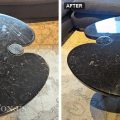
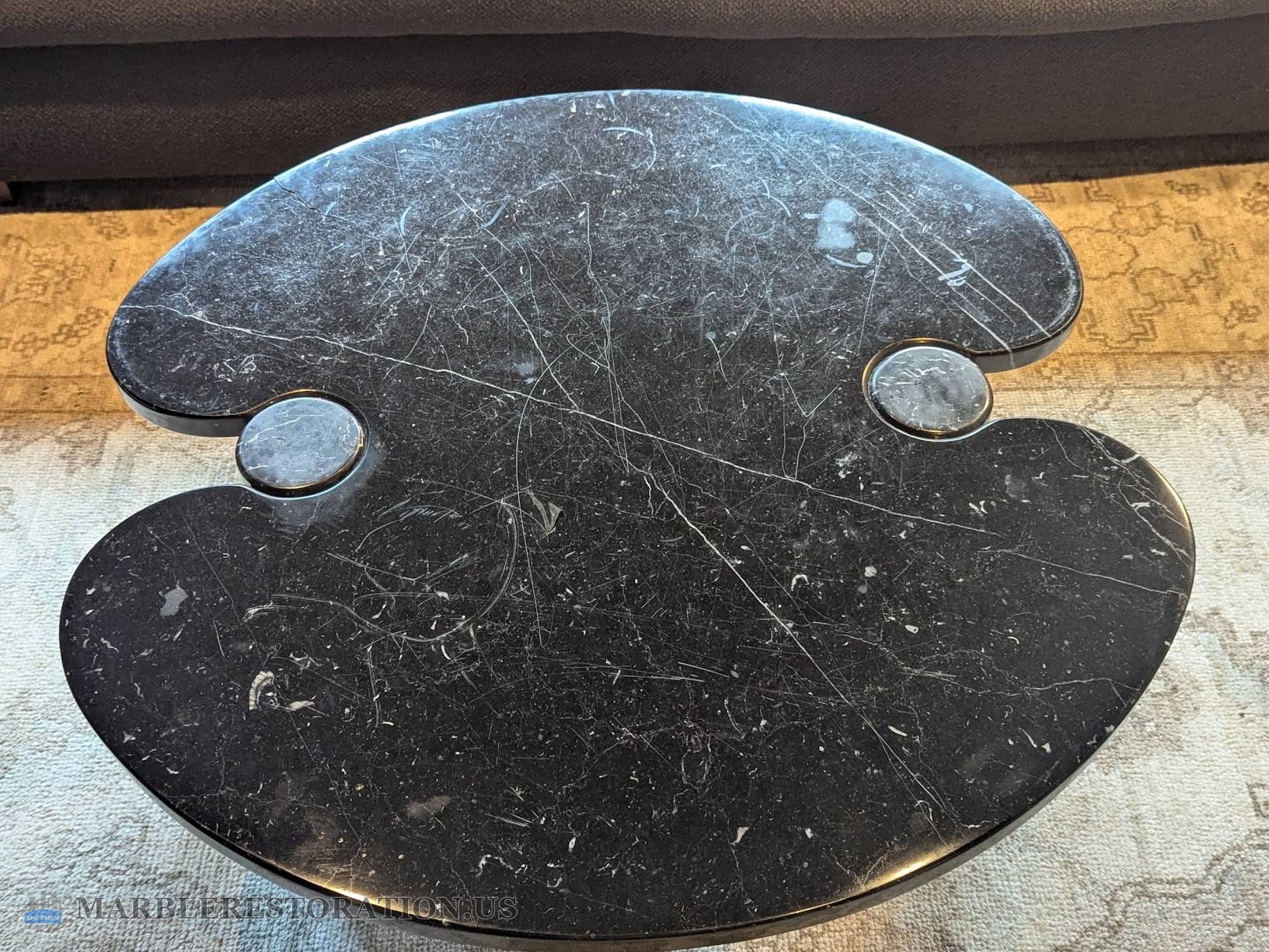
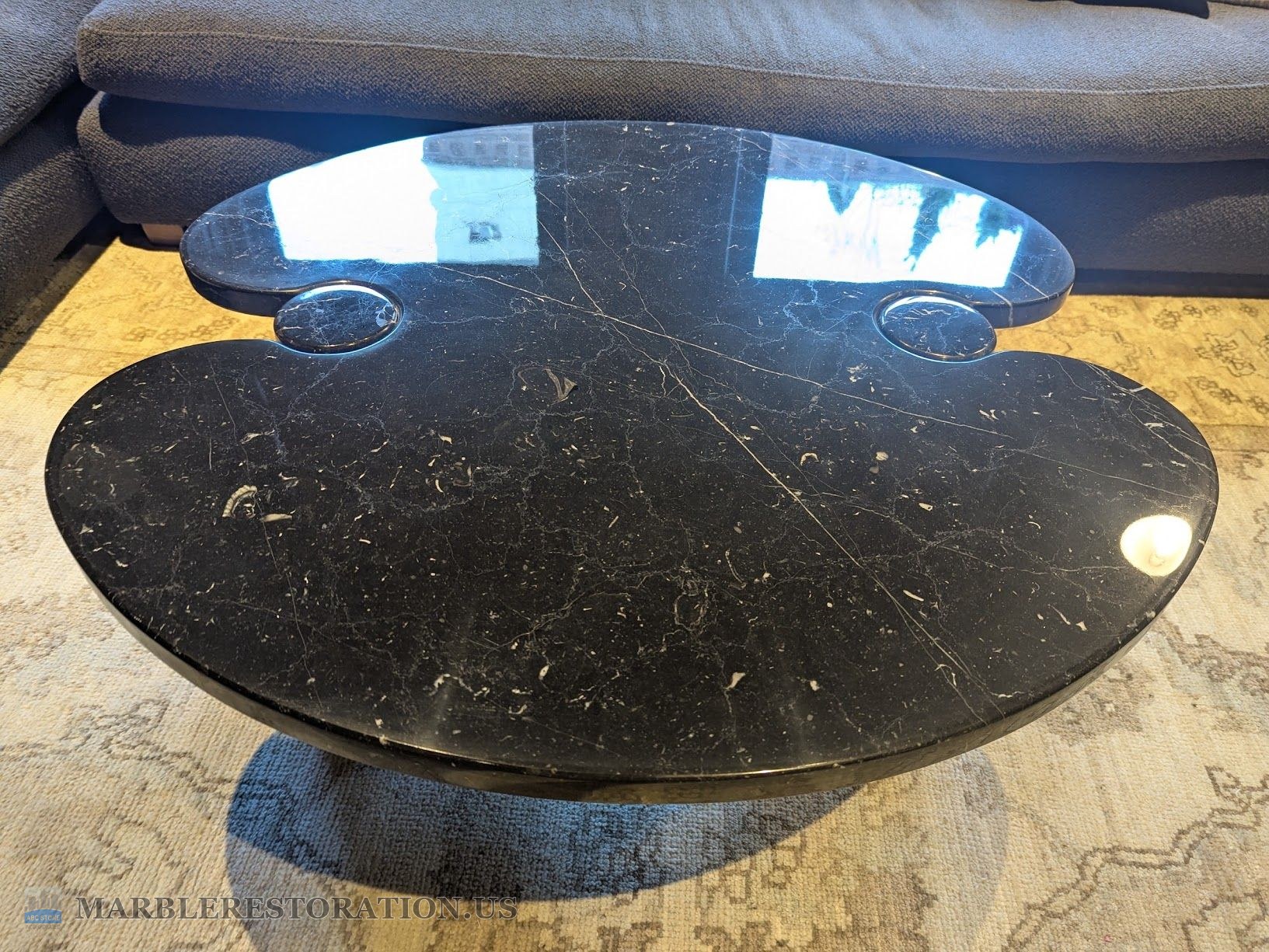
A mid-century Angelo Mangiarotti coffee table in black Nero Marquina marble, about 34 inches and round-ish, with a crack running completely through the slab. The crack started at the edge and went about 7 inches into the top. The owner asked me two things: the price, and what the process is. I filled the crack from top to bottom with black flowing epoxy and polished along the line. Then I re-polished the whole top so it looks uniform. The work was done at the owner’s home in Tribeca, Lower Manhattan, New York, NY 10013. It took one visit, about 6 hours, and the table didn’t have to be moved out.
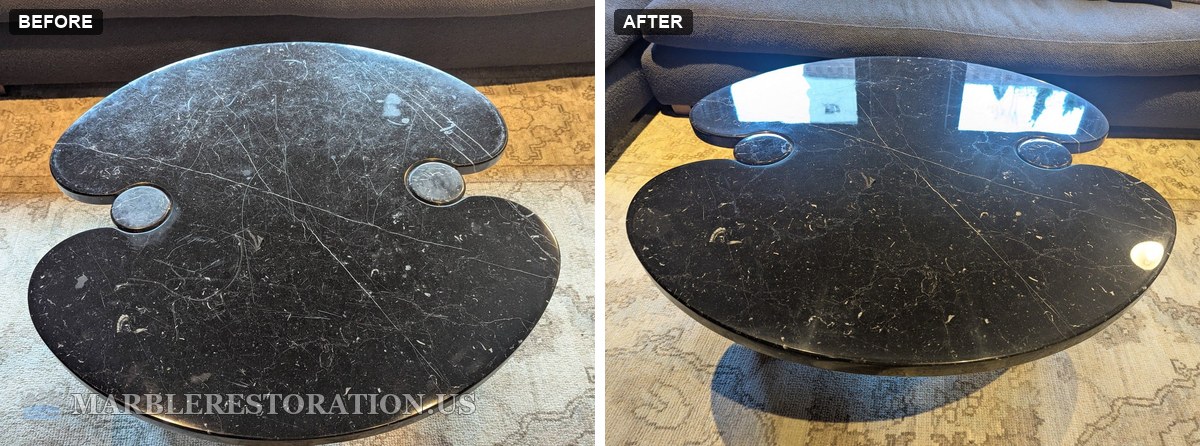
A crack that goes all the way through the slab
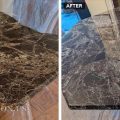
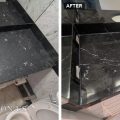
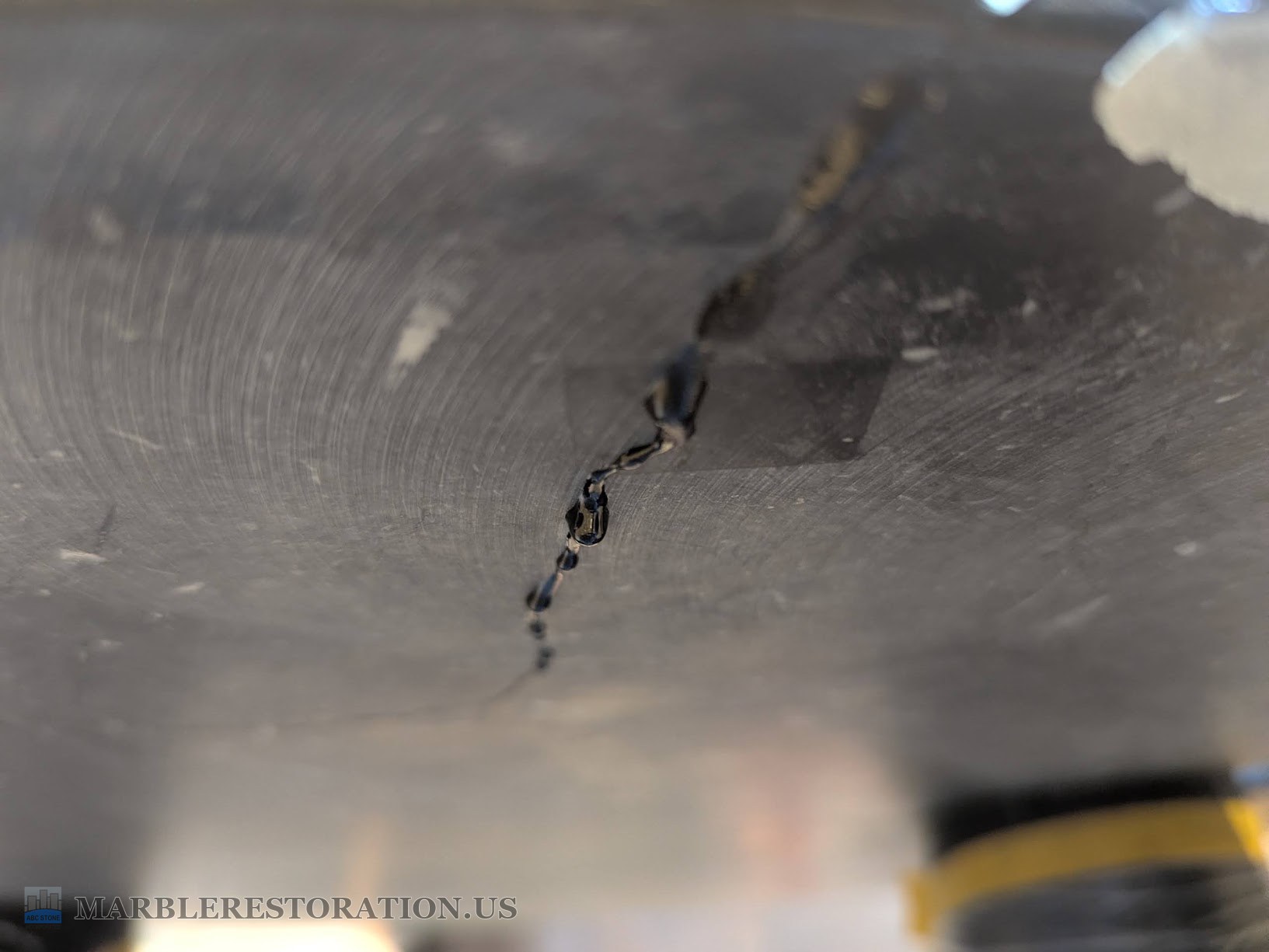
From across the room the top looked whole. Up close the crack was a thin dark line with a small gap, running from the edge toward the middle. On the edge it showed as a short line down the side, through the whole thickness of the stone. The owner wrote it twice: the crack goes all the way through the slab. That changes how the crack has to be filled.
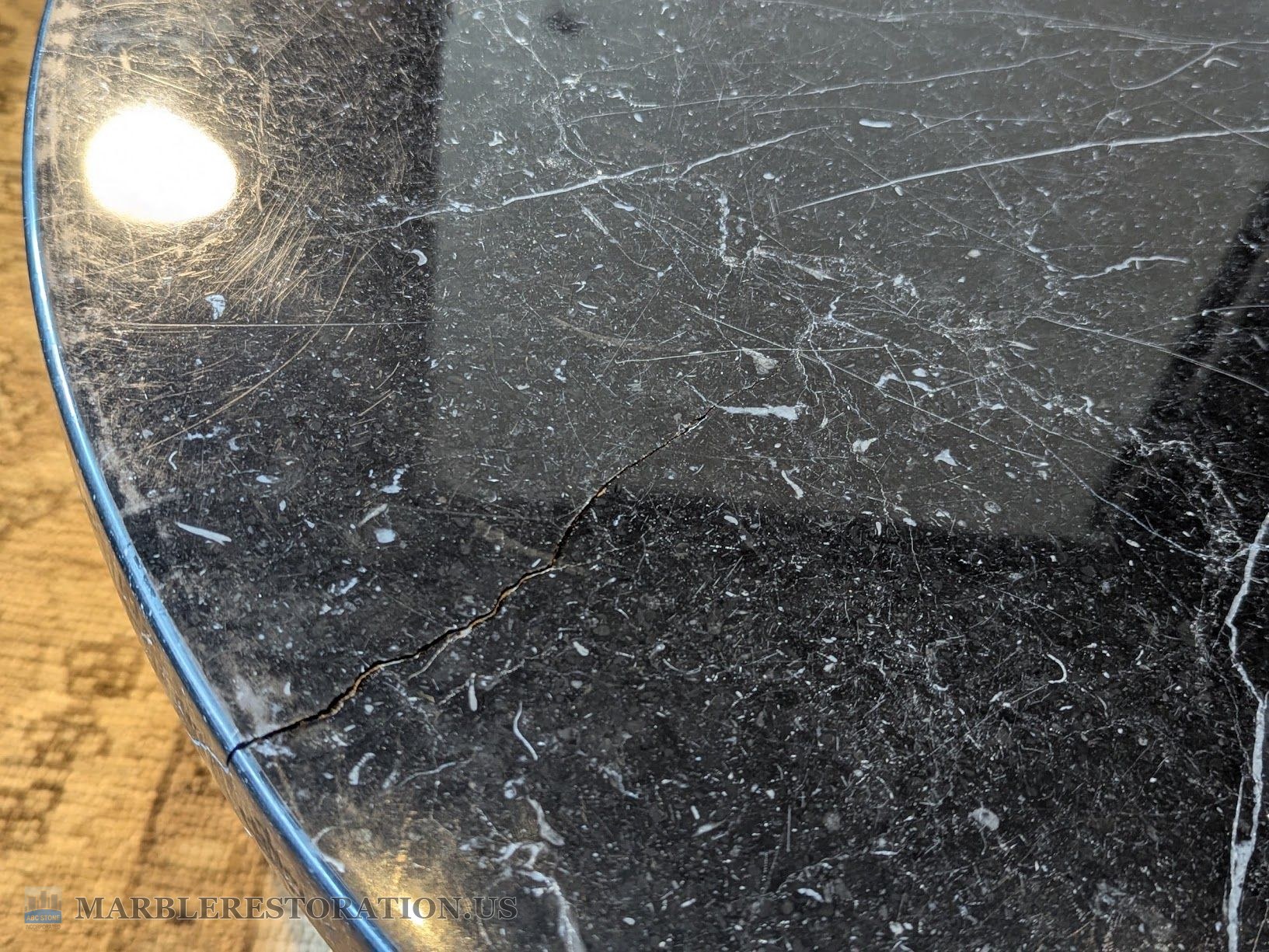
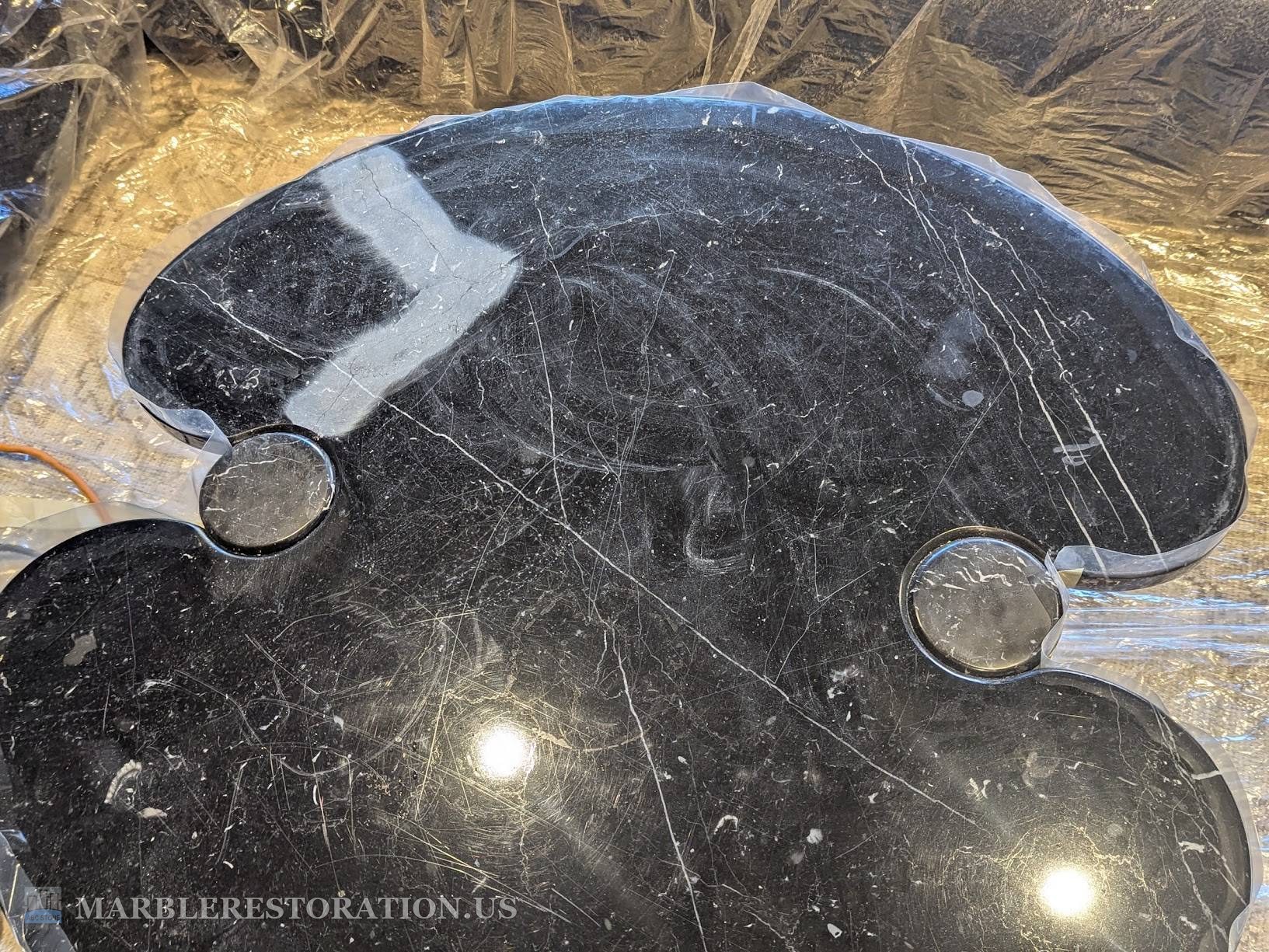
The rest of the top was worn: fine scratches everywhere, dull spots and white etch marks, and the shine gone in most places. That has nothing to do with the crack. But polishing only along the crack line would have left a shiny strip on a dull top, so the owner chose to re-polish the entire top too.
Flowing epoxy, not paste
A crack in stone can be filled two ways. A thick epoxy paste gets pressed in from the top. It closes the line you see, but it only goes into the top part of the crack, and the slab under it stays open. That fill is weak, because very little holds the two sides together.
Flowing (liquid) epoxy is thin when it goes in. It runs down into the crack and fills most of it, top to bottom, so the two sides are held together through the whole thickness. For a crack that goes all the way through, that is the strongest fill. On this table the epoxy came out on the underside, which is how I know it went all the way down.
The work was:
- cleaning out the crack, as deep as reachable
- filling the crack on the top and on the edge with black flowing epoxy
- sanding off the excess epoxy
- polishing and buffing along the crack line
- re-polishing the entire top to take out the scratches and etches
Marble is softer than granite, so it can be sanded and polished to a shine right next to the crack. On granite the same spot comes out flat but less shiny.
Done in place, nothing moved out
The floor, the rug and the sofa around the table were covered with plastic drop cloths, and I worked on the top right where it stands. The work makes some dust and a smell of epoxy, which is why everything around it gets covered.
What the owner was told, and how it came out
Before any work, the estimate said:
- The crack line will be visible, and it can be felt on touch.
- The two sides of the crack were uneven, so there can be a small wave on the surface along the line.
- The crack may come from tension inside the stone. If that is the cause, it can open again, and there is no guarantee.
- A polished strip along the crack line alone would look different from the rest of the top. With the whole top re-polished, it blends in.
- The deepest scratches and damage don’t all come out with a re-polish.
On this table it came out better than that. The crack line looks like one more vein in the Nero Marquina and is hard to notice. There is a very small wave along it, and it can’t be felt. Most of the scratches are gone. The estimate gives the limits that can happen, and every crack comes out a little different. The one limit that stays is that the crack can still open again.
Mid-century tables, the stone part only
I have restored many mid-century tables, Knoll Saarinen and others, like a chipped clear coat on a Saarinen marble table. I work only on the marble or stone part, not on the wood or other parts of the furniture. A black marble top with a crack inside it was filled the same way, with black flowing epoxy and on site, on an oval dining table with an internal crack. A round Nero Portora table had its cracks done too.
Questions people ask about cracked marble tables
Does black marble hide a crack better than white marble?
Yes. On black marble the fill is colored black, and on this Nero Marquina top the line ended up looking like a vein. On white marble the fill is matched to the gray veining, but a line or a patch on white marble always stays visible to some degree. White epoxy looks worse, it stays flat white and shows more.
My marble table top split in two. Can it be fixed?
Yes, the two pieces are glued back together with colored epoxy, then sanded and polished along the line. The glued line can be visible and can be felt on touch. It should be strong for normal use, but it can break again, in the same place or a new one, if it gets hit or extra force is put on it.
Is the repair better if the table is taken away?
Not for a crack like this one. The crack fill and the polishing are the same work at your home. Moving a big marble top back and forth is the easiest way to chip or crack it.
Is a mid-century marble table harder to repair than a new one?
Not because of its age. What makes an older table harder is what was done to it before: old epoxy from an earlier repair, or a clear coat on the top, like on the Saarinen tables.
Can a crack open again in an old table and in a new one too?
Both. A crack can come from tension inside the stone, and a new slab has it too. A filled crack can also open again if it gets hit or extra force is put on it.
If your marble table has a crack, send me a few photos or a short video. Tell me the size of the table, how long the crack is, and whether it goes through to the underside. I’m based in Brooklyn and work all over Manhattan and New York City. Email info@marblerestoration.us.
Submit Your Order or Ask a Question:
You'll get a response within a few minutes or hours and usually not longer than 24 hours.
 Oval Dining Table. Internal Crack Fixed
 Macchia Vecchia Square Coffee Table Top after Crack Reparation
 Marble Coffee Table with Gold Painted Flowers, Polished and Set on a New Base, Bed-Stuy
 Emperador Dark Dining Table after Split Repair
 Buckling Black Oval Table with Internal Crack
 Macchia Vecchia Square Coffee Table Top before Fracture Repair
 Fixed Indian Onyx Coffee Table
 Broken Knoll Saarinen 48 inch Round Black Marble Table
 Whole Round Table After Cracks Repair
 Coffee Table Leg Mounting
 Travertine Coffee Table Corner after Repair
 Clear Split on Thick Dining Table
 Fixed Knoll Saarinen 48 inch Round Black Marble Table
 Messed up Round Coffee Table Chap in Half
 Dining Marble Table Repair and Laminating
 Marble Table Restoration Service
 Ruined Rectangular Glazed Dining Table
 Fixed Corner of Conference Room Table
 Calacatta Gold Vanity after the Crack Repair
 Round Coffee Table with Newly Attached Metal Leg
 Broken off Corner on Travertine Coffee Table
 Marble-Bronze Tray-Table Side Shattered
 Fixed Round Coffee Table Top
 Drawer Top Crack Repair and Surface Polishing