Onyx Furniture Base Scratches Removed, Midtown Manhattan
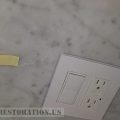
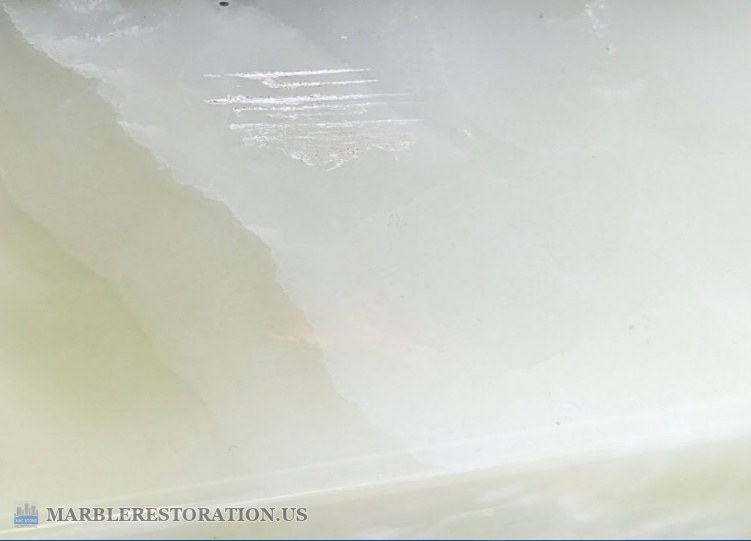
A patch of scratches, about one inch by one inch, on the onyx base of a designer furniture piece in Midtown Manhattan. This was not a fixture in a room. The piece was being prepared for an exhibition, with its drawer boxes sitting on the base, and the scratches were in plain sight on the top surface. It had to be done where it stood.
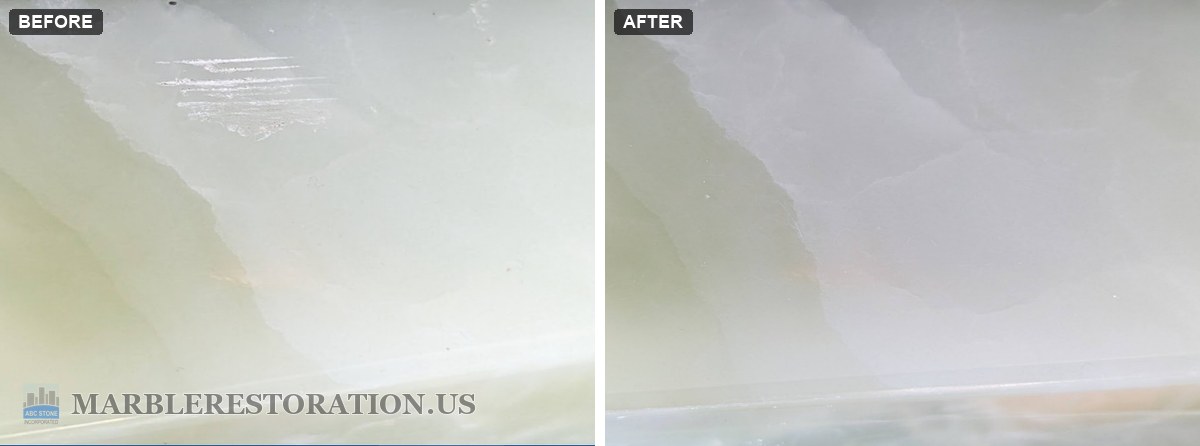
A one inch patch of scratches on a honed onyx base
The scratches were thin and shallow, a cluster of white lines in one small area. The rest of the surface was fine. The stone is a pale onyx with a green vein running through it, ordered from overseas for an interior designer. Onyx is a calcite stone, about as soft as marble, so it takes a mark easily and a scratch goes into the surface instead of skating off it. The owner wanted the honed finish kept and blended with the surrounding surface. From the photo the finish looked more semi shiny than matte to me, and that is what I matched.
Why I did not fill the scratches with epoxy
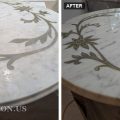
It was a fair question, and it came up before the work. Could color matched epoxy resin fill the scratches instead, and keep the surface flat? Three things say no. The scratches are thin and not deep enough for the epoxy to hold, so it will not last. Onyx is translucent, light goes into the stone and comes back out, and epoxy does not behave that way, so the filled lines stay visible. We have worked around that translucency before, on an onyx coffee table where metal reinforcing bars would have shown through the body of the stone. And after a fill, the extra epoxy still has to be sanded flat and polished, so the surface around the scratches gets sanded anyway.
Filling covers a scratch. Sanding takes it out.
Sanding to the depth of the scratches
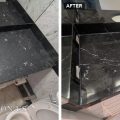
The work is quick to describe and slow to do. I sand the spot down to the bottom of the scratches, then polish back up with diamond pads, step by step through the grits, until the finish comes back. No cleaning step is needed afterwards, freshly polished stone is already clean. A couple of hours on site, start to finish. The drawer boxes stayed on the base and the area around the spot went under plastic drop cloths. The same approach took the scratches out of a Carrara kitchen backsplash and brought back a dull black marble vanity top a few blocks away in Midtown.
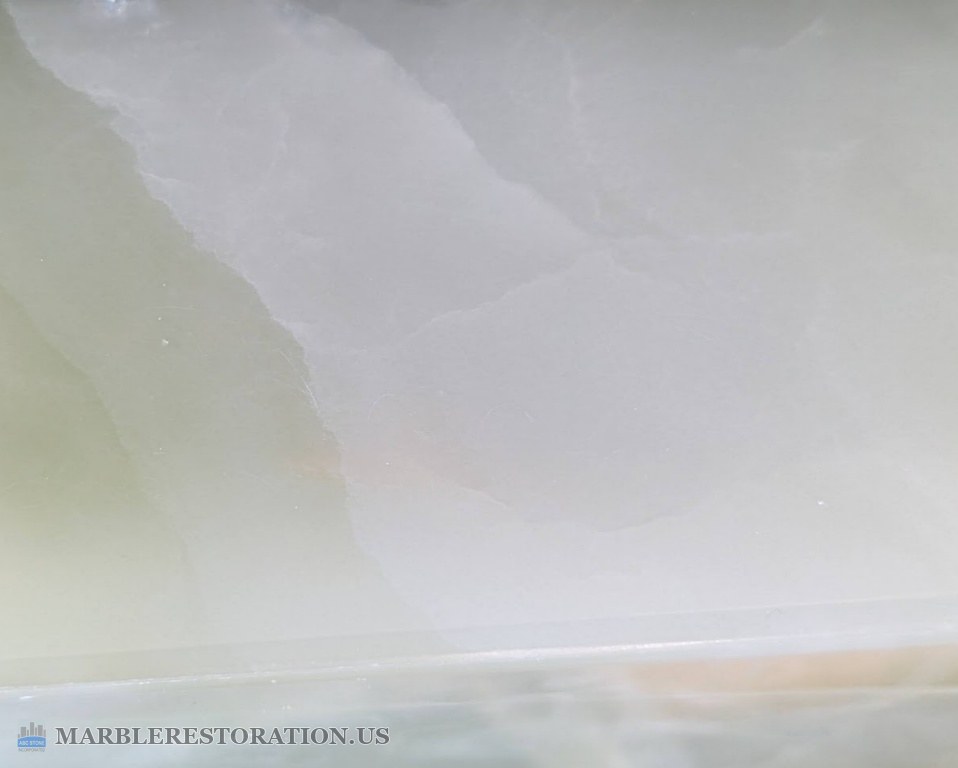
What a deep sanding leaves behind
Here is the part most companies leave off the page. Taking stone down to the depth of a scratch means taking material away, and that leaves a wave on the surface. It can be noticeable, and it runs wider and smoother than the scratched spot did. The newly polished finish can also come out slightly different from the original factory finish, and on a translucent stone like onyx that difference shows more than it would on a dense marble.
On this base it came out well. There is almost no wave and it is hard to notice. I still say it the other way round before any job like this, because the wave is the real risk of a deep sanding and how much of it you get depends on how deep the scratches go. I match the finish as close as I can. Close is not the same as identical.
Sealing, and what it will not do
I sealed the polished area with Aqua Mix Sealer’s Choice Gold, a water based penetrating sealer. It soaks into the stone rather than sitting on top as a coat, so it will not change the appearance or alter the finish. It may help protect from some color stains. It will not protect from etching, watermarks or new scratches. Nothing does.
Questions people ask about scratches on onyx
Can scratches be sanded out of an onyx surface?
Yes. Onyx sands and polishes like marble. The spot is taken down to the depth of the scratches and polished back up through the grits. What you trade for it is a wave on the surface and a finish that can read slightly different from the factory one.
Can you fill the scratches with color matched epoxy instead?
Not on thin scratches, and not on onyx. They are too shallow for epoxy to hold, onyx is translucent so the fill stays visible, and the excess epoxy has to be sanded and polished anyway.
Does the furniture have to come off the base?
Usually not. On this one the drawer boxes stayed on the base while the spot was sanded and polished, and the area around it was covered with plastic drop cloths.
How long does a spot like this take?
A couple of hours on site for a one inch area, including the sealing.
Can this be done in an apartment, or does the piece have to go to a shop?
A spot like this is done on site. We are based in Brooklyn and work across Manhattan, and a one spot job is a single visit.
Send a photo
If you have a scratched spot on onyx or marble, send me a photo and tell me roughly how big it is. That is usually enough for a price and a straight answer about what will be left behind. We cover Manhattan and the rest of the city, and this job was in Turtle Bay, Midtown East, Manhattan, New York, NY 10022. More on the work itself is on the scratches removal page. Email me at info@marblerestoration.us.
Submit Your Order or Ask a Question:
You'll get a response within a few minutes or hours and usually not longer than 24 hours.