
Chipped Clear Coat on a Saarinen Marble Table, Filled in Sagaponack, NY. Before and After
A chip the size of a quarter in the clear coat of a 54 by 96 inch Saarinen oval dining table. A guest dropped something on the table and it knocked a piece out of the coat. The marble under it was fine. Only the glossy coat on top broke off, and bare marble showed through. The table is in Sagaponack, NY 11962, in the Town of Southampton, Suffolk County. That is the Hamptons, on the East End of Long Island, about 100 miles from Brooklyn.
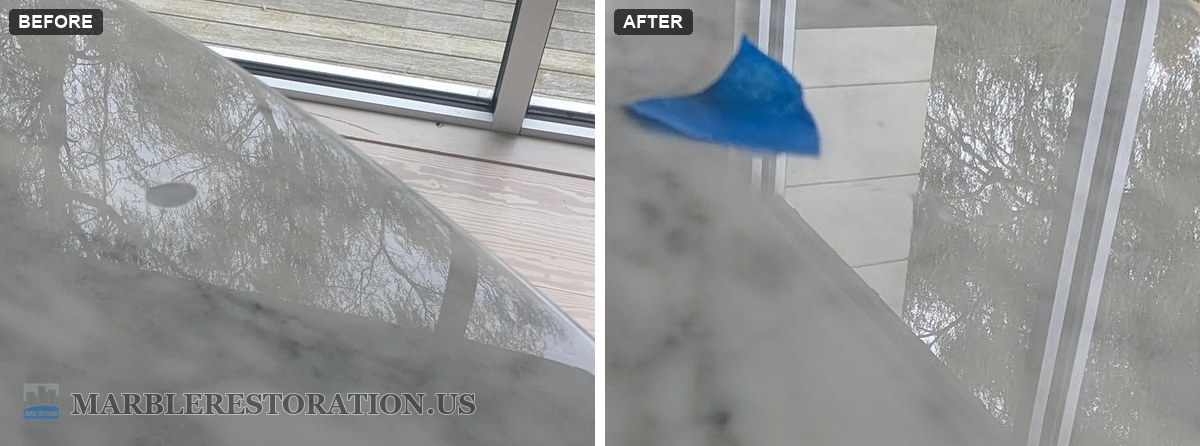
The owner asked what I hear a lot about these tables: can a chipped epoxy finish be fixed in one spot?
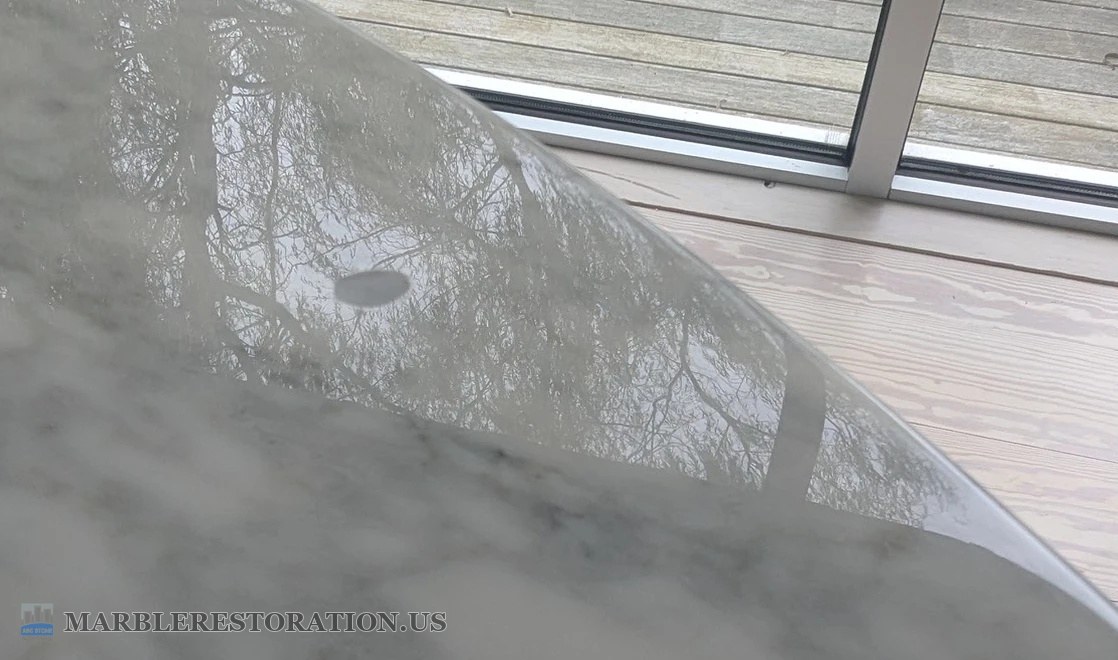
Why a chip in the coat is its own problem
Many Saarinen tables have a clear coat over the marble. It’s a hard, glass-like layer, and the shine you see comes from the coat, not the stone. When a chip goes through it, the spot has two different materials, bare marble in the middle and coat around it.
Marble can be polished. The coat doesn’t polish well. If I sand and polish a chip in the coat, that spot comes out a different gloss from the rest of the top, and on a mirror surface every difference shows. So a chip in a coat is never sanded out. It gets filled, or the whole coat gets replaced.
Where the chip is matters. A small chip on the flat top can be filled. Clear epoxy is poured into it and it fills the spot. A chip on the edge is different. The liquid epoxy runs over the edge and there is nothing to hold it in place, so an edge chip in the coat can’t be restored properly with a fill. That one goes away only with a new coat on the whole top. This chip was on the flat surface, away from the edge, so it could be filled.
Any coat can chip if something hard lands on it. An old coat chips easier. It gets fragile with age, likely after 10 years or more, and a new coat is stronger.
Two options, and the one chosen
I gave the owner two choices.
- Re-coat the whole top. The old coat comes off the whole table, the marble is smoothed and prepared, and a new clear coat goes on. The chip goes away with the old coat. The marble under it was not damaged, so there was nothing to patch. This is the proper fix. On a top this size it may take one or two days, all done in the house.
- Fill only the chip with the same kind of clear epoxy used for a new coat. The rest of the old coat stays as it is. It’s a smaller job and one visit, but the spot will be visible. This option was there only because the chip was on the flat top.
The owner went with the spot fill for now. I poured clear epoxy into the chip on site, so the bare marble is covered again.
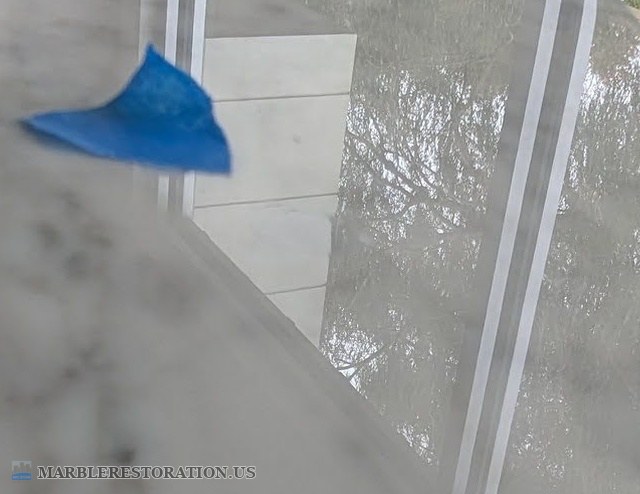
What the filled spot looks like, honestly
The bare marble is covered, but I won’t call the fill invisible.
- The filled spot will be visible. It can come out a different color or clarity, uneven, or shinier than the coat around it, and you may feel it on touch. That’s not a bad fill. It’s new epoxy next to a coat that has aged for years, and the two will never be the same.
- The rest of the old coat stays as it was, with its age, its wear and any yellowing it already has.
- A fill doesn’t make an old coat stronger. Another hard knock can chip it in a new place.
- If the whole top is re-coated later, the fill comes off with the old coat.
What a full re-coat gets you, and its limits
A new coat is stronger than an old, fragile one, and the whole top comes out as one even, high-gloss surface. The limits there are real too. The new coat can have minor imperfections like dust particles, small bubbles or slight surface waves. It can be scratched or chipped, same as the original. Over time it may turn slightly yellow, all resins eventually yellow. The finish is high gloss only, a coat can’t be made matte. It cures in 24 hours, and the full cure takes 7 days.
Questions people ask about chipped table coats
Can a chip in the clear coat be polished out?
No. The coat doesn’t polish well, and a polished spot looks different from the coat around it. A small chip on the flat top can be filled, or the whole coat can be replaced.
Can a chip on the edge of the coat be filled?
Not properly. The epoxy overflows and runs down the edge before it sets. A chip on the edge goes away only when the whole top is re-coated.
If I re-coat the table, will it look like new?
It will be one even, high-gloss surface with the chip gone. It won’t be factory perfect. A small dust speck or a tiny bubble can be in a new coat, and you should know that before you decide.
Does the table have to leave the house?
No. The work is done on site, in any room at room temperature, with the floor and surroundings covered.
If your table has a chip in the coat, send me two photos, one close up and one of the whole table, and the size. I’ll tell you if the chip is in the coat only or in the marble too, and what each option involves. I’m based in Brooklyn and work across New York City and Long Island, out to the Hamptons. Email info@marblerestoration.us.
Submit Your Order or Ask a Question:
You'll get a response within a few minutes or hours and usually not longer than 24 hours.
 Knoll Saarinen Table Laminating. Clear Finish
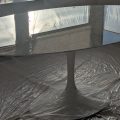 New Coat on Eero Saarinen Oval 78″ Table
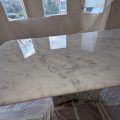 UV-Resistant Clear Epoxy Applied
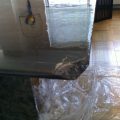 Transparent Coat Flake off Repair on Dining Table
 Knoll Saarinen Marble Table Recoating: Full Strip-and-Recoat Process
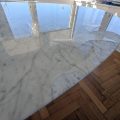 Eero Saarinen Oval 78″ Table – Aged Peel Off
 Knoll Saarinen Coffee Table.
 Chip and Crack
 Coffee Table Coated by Transparent Epoxy Polyester
 Honed Table Before Coating with Transparent Polyester
Table Re-Coating Service with Transparent Polyester Resin
Honed Table Before Coating with Transparent Polyester
Table Re-Coating Service with Transparent Polyester Resin
 Yellow Coat Mechanical Delamination
 Marble Windowsill High-Gloss Finish After Transparent Polyester Coating
 Pitted & Weathered Marble Windowsill Before Polyester Resin Coating
 Restored Transparent Polyester on Broken Corner